Choosing a solar PV system involves more decisions than most homeowners expect—and one of the most consequential is the type of inverter you install. The inverter is the technology that converts the electricity your panels generate into power your home can actually use. Get it right, and your system performs at its best for many years. This guide explains how string inverters and microinverters differ, and what that means in practice for your home.
How does a solar inverter work?
Solar panels generate direct current (DC) electricity. Your home runs on alternating current (AC). An inverter converts the DC output from your panels into usable AC electricity—powering your appliances, charging a battery, or exporting surplus energy to the grid via the Smart Export Guarantee (SEG).
The two most common inverter types for residential solar are string inverters and microinverters. They achieve the same fundamental goal but in very different ways—and those differences have real implications for performance, reliability, and long-term value.
What is a string inverter?
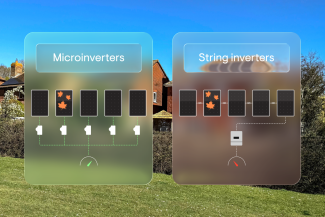
A string inverter is a single centralised unit, typically wall-mounted in a garage or utility room, that receives DC electricity from a series-connected string of solar panels and converts it to AC. Today, many homeowners are being offered a hybrid inverter with an integrated battery, rather than a standalone unit. While this adds storage capability, the core limitation remains: all panels are tied together, so one underperforming panel reduces the output of the entire string. The unit is also a single point of failure; if it develops a fault, the whole system, including the battery, stops generating until it is repaired or replaced. Most string inverters carry a warranty of 5–12 years, well short of the 25-year lifespan of the panels themselves.
Some string inverter systems include panel-level power optimisers to partially address shading and performance mismatch. These condition each panel's DC output before it reaches the central inverter, reducing the drag effect of shading. However, the central inverter remains a single point of failure, and optimisers do not deliver the same panel-level independence, resilience, or monitoring capability as a microinverter. Optimisers also add another component to maintain on the roof.
What is a microinverter?
A microinverter is a small inverter fitted at roof level behind each individual PV panel. Rather than converting DC from the whole array in one central unit, each panel converts its own output to AC independently—maximising continuous production. The Enphase IQ9 Microinverter is the latest generation of this technology, built with advanced Gallium Nitride (GaN) semiconductor technology that runs cooler and more efficiently than previous inverter generations, achieving up to 98% peak efficiency.
Because every panel operates independently, shading or soiling on one panel has no effect on the rest of the system. Each panel always produces its maximum possible output. The IQ9 Series Microinverter also includes low voltage start-up—allowing generation to begin from the first available light—and Burst Mode technology, which captures energy in low light conditions such as just after sunrise, just before sunset, when panels are partially shaded, or on an overcast UK winter’s day. On a typical residential roof, where some degree of shading or variable light is inevitable, this means your system is generating useful energy at times when a string inverter simply would not be.
Safety is another important distinction. Using a string inverter means high-voltage DC electricity is carried in cables from the roof to the inverter unit—a potential hazard in the event of a fire or emergency. Enphase IQ9 Series Microinverters keep the system at low voltage throughout, and include built-in rapid shutdown, which allows the system to be instantly made safe for utility workers and first responders in the event of an emergency.
The IQ9 Series Microinverter is also IP67-certified with a double-insulated, corrosion-resistant polymer housing—engineered to withstand rain, temperature extremes, and the long-term demands of rooftop exposure. And because Enphase regularly delivers over-the-air software updates, your system can receive new features and performance improvements throughout its lifetime without hardware changes.
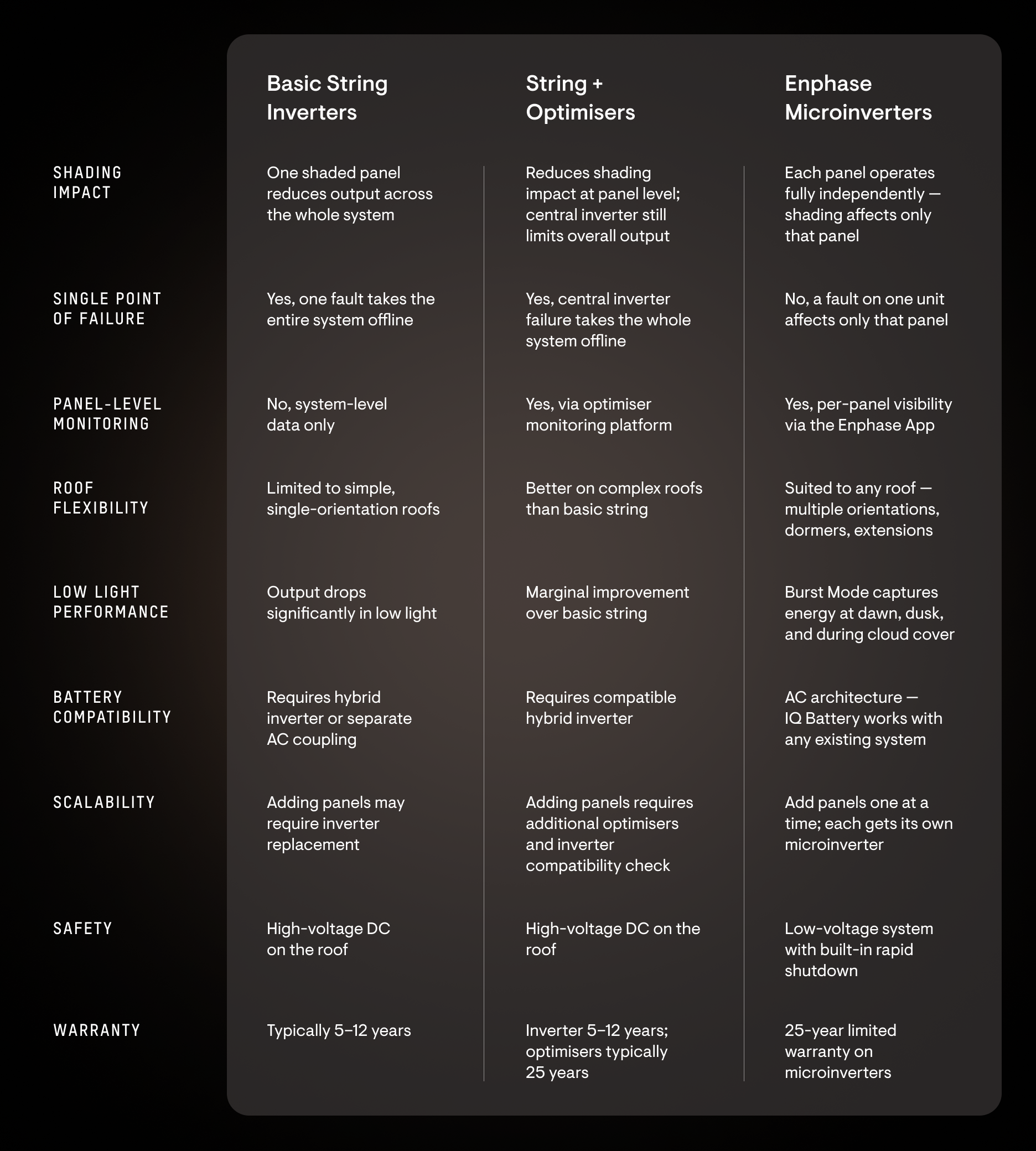
How they compare
What does this mean for your roof?
Every roof suffers from some degree of shading from cloud cover; some also have shading from a chimney, a neighbouring tree or maybe a dormer window. With a string inverter, any shading at any point during the day reduces the output of every panel connected to that string. With microinverters, shading is isolated to the affected panel only—the rest of the system continues generating at full capacity. On a roof with even occasional shading, the difference in annual energy yield is significant.
Many homes also have roofs that face more than one direction, or have panels across different elevations. Panels on a south-facing roof deliver peak output at midday; those on an east-facing roof peak in the morning. In a string inverter system, panels on different orientations are forced to operate in lockstep—the lowest-performing panels at any given moment constrain the rest. With microinverters, each panel peaks independently, and the system captures the maximum available output from every panel regardless of orientation.
For homeowners thinking ahead to battery storage or EV charging, the Enphase IQ Battery uses AC architecture, meaning it can be retrofitted to any existing solar PV system. And because each panel has its own microinverter, the system can be expanded one panel at a time without replacing any existing equipment.
Reliability and warranty: The long-term view
Solar PV panels are typically warranted for 25 years. A string inverter warranted for 5–12 years will almost certainly need replacing at least once during that period, adding cost and creating downtime for the whole system. When it fails, every panel stops generating.
Enphase IQ9 Series Microinverters carry an industry-leading 25-year limited warranty—matched to the warranty of the panels themselves. Because each panel has its own inverter, a fault on one unit affects only that panel, while the rest of the system continues generating. Panel-level monitoring via the Enphase App means any underperforming unit is flagged immediately, and your certified Enphase installer can resolve it quickly without taking the whole system offline.
Ready to get more from every panel?
Frequently Asked Questions
With a string inverter, all panels are electrically linked — one shaded panel pulls the entire string's output down. Microinverters break this dependency entirely. Each panel operates and converts its electricity independently, so shading or soiling on one panel has no effect on the rest of the system. On any roof with shading, this can make a significant difference to total annual energy generation.
The IQ9 Series Microinverter is built with Gallium Nitride (GaN) semiconductor technology, which runs cooler and more efficiently than silicon-based inverters, achieving up to 98% peak efficiency. It is IP67 certified for weatherproofing, features a double-insulated polymer casing for safety, and includes built-in rapid shutdown. It also receives over-the-air software updates, meaning performance improvements are delivered automatically over the system's lifetime.
Yes. The Enphase IQ Battery uses AC architecture, meaning it can be retrofitted to any existing solar PV system — including those with string inverters — without needing to replace the inverter. If battery storage is part of your plan from the start, discuss this with your installer before choosing your inverter type.
Only the panel served by that microinverter is affected — all the other panels continue generating as normal. The Enphase App flags the underperforming unit automatically, and your installer can replace it without taking the rest of the system offline. All Enphase IQ9 Series Microinverters are covered by a 25-year limited warranty.
A certified Enphase installer will carry out a full site survey — assessing your roof's orientation, shading profile, and your household's energy goals — and design a system tailored to your property.