Solar panels can generate electricity for over 25 years, offering a cost-effective way to reduce electricity expenses despite high initial costs. The payback period—the time needed for the savings on electricity bills to cover the upfront investment—varies by homeowner. Estimating your return on investment (ROI) can feel complex if you are new to solar power.
This guide explains ROI, outlines steps to calculate your payback period, and shares tips to maximise savings.
Understanding solar power ROI
Investing in a solar system can save you money by comparing lifetime energy savings with the total installation cost.
Total solar system cost
The cost of installing solar systems includes expenses for hardware, labour, permits, and overheads. However, the final cost may vary depending on factors such as system size, roof type, location, and available subsidies. Certain states in India offer additional subsidies alongside the central subsidy provided under the PM Surya Ghar Muft Bijli Yojana. These combined subsidies can lower the cost of solar energy systems by making solar power significantly more affordable for homeowners. Solar installation costs depend on many unique variables, including:
- System design: Number and type of solar panels, complexity of the roof, type of inverter, and battery storage directly affect the cost and efficiency.
- Installer selection: Costs can vary between installers due to different pricing models, system designs, overhead costs, and warranty options.
- Property upgrades: Additional expenses may arise if your property requires roof replacement or other structural improvements.
- Financing terms: Financing terms such as interest rates and loan durations can significantly impact total costs and savings.
- Solar incentives: Eligibility for government subsidies can lower installation costs and improve affordability.
Home solar energy savings
To calculate your solar ROI, you need to figure out how much you can save on energy costs compared to the system’s total price.
The best way to estimate your savings is by talking to a certified solar installer in your area. They use advanced tools and local knowledge to give accurate ROI calculations.
A good solar setup significantly lowers your monthly electricity bills, leaving only a few fixed charges imposed by the distribution companies (DISCOMs). The exact savings depend on:
- System performance: The amount of electricity your solar system generates daily, yearly, and over a lifetime depends on factors like sunlight hours, system size, system efficiency, roof design, maintenance, and equipment lifespan.
- Electricity rates: Higher electricity rates in your area mean greater savings on electricity bills, plus added protection against future energy price increases.
- Solar billing rates: The savings made from sending extra solar energy to the grid depend on your DISCOM’s net metering or billing policies.
- Subsidies: Participation in government schemes can significantly enhance the financial benefits of adopting solar energy. Both central and state governments provide subsidies and incentives to encourage the use of solar power.
How to calculate your solar payback period and ROI
One of the best ways to understand if your solar system is worth the investment is to calculate your payback period. This is the time it takes for your energy savings to cover your installation costs, often called the break-even point.
The payback period for solar systems in India could be as low as 3 to 5 years, though it depends on factors like your system specifics, location, and future changes in electricity rates or system performance. You can estimate your payback period by following these simple steps:
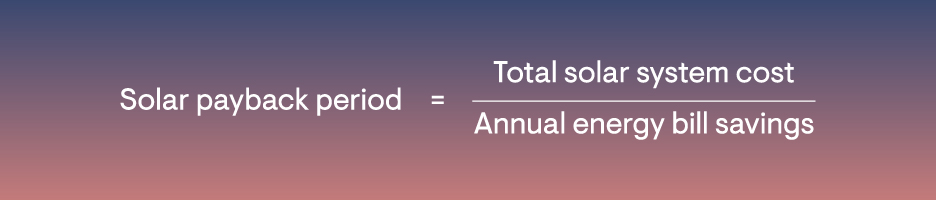
- Determine your total solar system costs.
- Estimate your annual energy bill savings.
- Divide your system cost by your annual energy bill savings.
For example, let’s say you install a 3-kW solar energy system for ₹2,10,000. If you qualify for a government subsidy under the PM Surya Ghar Muft Bijli Yojana, which provides up to ₹78,000 for a 3-kW system for residential users, your net system cost would be reduced to ₹1,32,000.
To estimate savings, assume your system offsets 100% of your monthly electricity bill (apart from fixed charges), which amounts to approximately ₹3,000 per month or ₹36,000 annually. By dividing the net cost of ₹1,32,000 by ₹36,000, your solar payback period would be less than 4 years. Over the 25-year lifespan of the system, it could effectively “pay for itself” multiple times through avoided electricity costs.
Maximise your solar energy installation ROI
Here are some effective tips to maximise long-term savings, shorten your payback period, and boost your solar power ROI:
- Design your ideal energy system with the help of a professional based on your home’s electricity demand.
- Determine if adding a solar battery is a cost-effective option for maximising savings. Batteries can store excess energy for later use, especially during outages or at night.
- Invest in high-efficiency solar panels and microinverters to ensure maximum energy generation. Quality components enhance long-term performance and durability.
- Utilise schemes like the PM Surya Ghar Muft Bijli Yojana, which offers subsidies and financial support to lower installation costs.
- Ensure regular maintenance, including solar panel cleaning and of energy production, to help maintain peak performance and extend the lifespan of your system.
Unlock long-term savings with solar power
Switching to solar power is a smart financial move, offering reduced energy costs and protection against rising electricity rates. By calculating your ROI and payback period, you can achieve returns within a few years and enjoy long-term savings.
Enphase Energy Systems—with advanced microinverters, seamless battery backup, and real-time monitoring—provide unmatched reliability, efficiency, and safety. Their high performance can significantly enhance your ROI, ensuring quicker payback periods and greater long-term savings.
Use Enphase’s System Estimator to calculate your potential savings and make an informed transition to solar power with confidence and peace of mind.