
Understanding how much electricity your appliances use is key to getting the most from your solar system, backup generator, or even your monthly energy plan. In this blog, we break down the average wattage of common household devices—like TVs, refrigerators, air conditioners, and microwaves—and explain how that translates into real energy use, costs, and savings.
Home appliances wattage chart
Here’s a quick reference chart showing the typical power usage of common household appliances.
Note: Wattage (W) tells you how much electricity an appliance uses at a given moment. To estimate your energy bill, you’ll want to know how many kilowatt-hours (kWh) it uses—that’s watts × hours used ÷ 1,000.
For example, a 1,500 W space heater running for 3 hours = 4.5 kWh.
| Appliance | Wattage range (Watts) | Notes |
| TV | 50–400 W | Power varies by screen size and technology; OLED and plasma use more |
| Refrigerator | 100–800 W | Runs 24/7; average use is lower due to cycling on and off |
| Air conditioner | 500–3,500 W | Central AC systems use the most; usage increases in hot climates |
| Microwave oven | 600–1,200 W | High draw while running, but usually used for short duration |
| Electric oven | 2,000–5,000 W | Uses high power for extended periods when baking or roasting |
| Washing machine | 400–1,400 W | Higher energy use if connected to hot water or using internal heating |
| Clothes dryer | 1,800–5,000 W | Draws a lot of power, especially during long cycles |
| Dishwasher | 1,200–2,400 W | Most energy used during drying; shorter, air-dry cycles save power |
| Space heater | 750–1,500 W | High power use during cold months; can add up quickly |
How many watts does a TV use?
Average wattage: 50–400 W (watts)
Televisions vary widely in their power consumption depending on the screen size and display technology. Smaller LED models are quite efficient, while older plasma screens draw significantly more power.
For example:
- 32” LED TV: 30 to 70 W
- 50” LED TV: 100 to 150 W
- 65” 4K OLED TV: 150 to 250 W
- Older plasma TVs: up to 400 W
Tip: Turning on energy-saving or eco mode can reduce your TV’s power usage by up to 20–30%, without sacrificing picture quality.
How much power does a refrigerator use?
Average wattage: 100–800 W
(Note: Actual usage averages 150–250 W over time due to intermittent cycling)
Refrigerators run around the clock, making them one of the most consistently active appliances in your home. The power they consume depends on their size, efficiency rating, and design type.
Typical usage by model:
- Mini fridges: 100 to 250 W
- Top-freezer models (16–20 cu. ft.): 300 to 500 W
- Larger side-by-side or French door models: 500 to 800 W
Newer, energy-efficient models with improved insulation and compressors use significantly less power than older refrigerators. Modern ENERGY STAR-certified refrigerators are about 9% more energy efficient than models that meet the federal minimum energy efficiency standard.
How many watts does an air conditioner use?
Average wattage: 500–3,500 W
Air conditioners are among the highest energy-consuming appliances especially during summer months or in hot climates. Power usage depends on the type of AC, its cooling capacity, and how well your home is insulated.
Here's a breakdown:
- Window AC unit: 500 to 1,500 W
- A portable AC: 1,000 to 2,000 W
- Central AC system*: 2,000 to 3,500 W
If your AC runs frequently or your thermostat is set too low, it can significantly raise your electricity bill. Air conditioning alone uses about 2,365 kWh per year on average—and in hotter regions like Phoenix, usage can exceed 5,900 kWh. Explore city-wise cooling energy use and electricity costs in this breakdown.
Smart tip: Use a programmable thermostat and seal air leaks to improve efficiency and reduce your cooling costs by up to 20%.
How much electricity does a microwave use?
Average wattage: 600–1,200 W
Microwaves are high-power appliances, but they're usually used for short bursts—just a few minutes at a time—so their overall impact on your energy bill tends to be modest.
Depending on size:
- Compact microwaves (0.7–0.9 cu. ft.): 600 to 900 W
- Full-size models (1.2–1.6 cu. ft.): draw about 1,000 to 1,200 W
Used 10 minutes a day, a microwave adds about 5 kWh/month—small, but worth tracking if you're monitoring usage.
Now that you know what your appliances use, here’s how it translates to your monthly energy costs.
How appliance wattage affects your electricity bill
The more power an appliance uses, and the longer it runs, the more it adds to your electricity bill. Since electricity is billed in kilowatt-hours (kWh), even small differences in wattage can add up over time.
Use this simple formula to estimate how much an appliance costs to run each month:
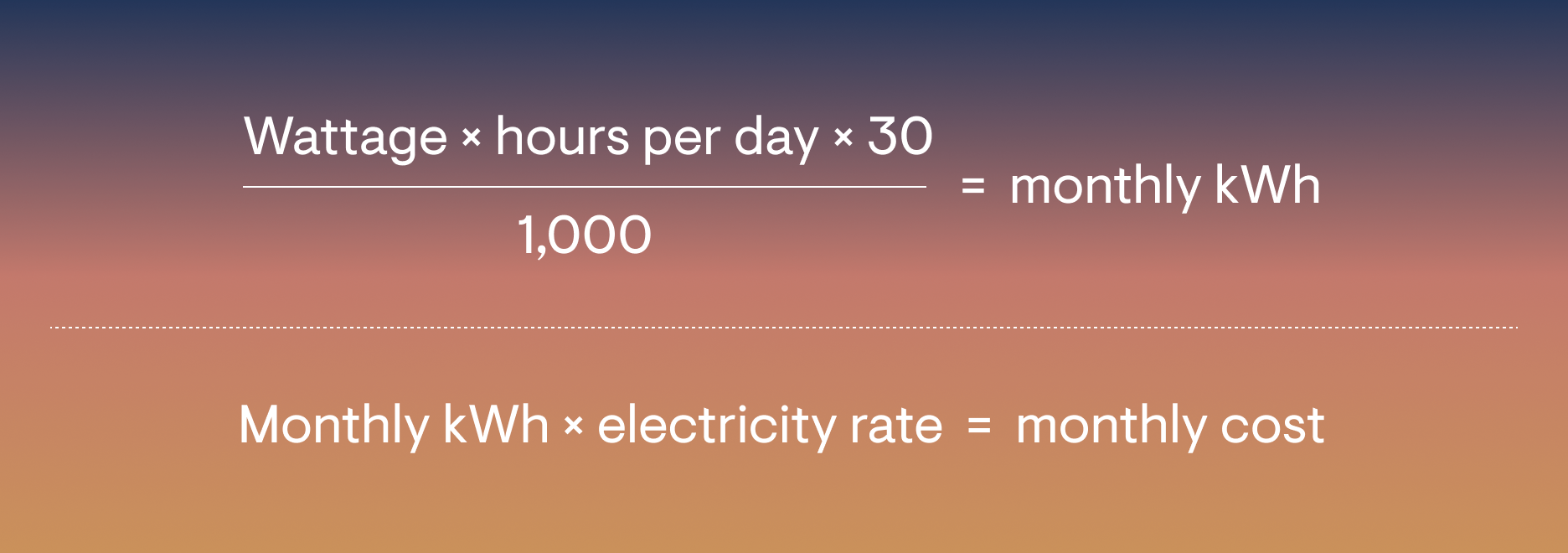
Let’s break it down with an example:
A 1,200-watt microwave used for about 10 minutes a day (which is 0.17 hours):
1,200 × 0.17 × 30 ÷ 1,000 = 6.1 kWh/month
6.1 × $0.16 (avg. U.S. rate in 2024) = $0.98/month
Multiply this across all appliances to see where your energy spend is going and where you can save.
Smart ways to cut appliance energy use
- Choose ENERGY STAR® appliances—they use lesser power without sacrificing performance.
- Unplug idle devices or use smart strips to eliminate phantom loads.
- Set programmable thermostats and timers to reduce unnecessary use.
- Run large appliances during off-peak hours to save on time-of-use rates.
- Clean filters, vents, and coils regularly for better appliance efficiency.
- Use LED lighting and low-flow fixtures to lower overall energy use.
How many solar panels are required for home appliances?
Here are the number of solar panels that are needed for some of these common home appliances.
| Appliance | Daily use | Power (W) | Daily energy (Wh) | Panels needed* (400W/panel) |
| TV (50" LED) | 5 hrs | 120 W | 600 Wh | 1 panel |
| Refrigerator | 24 hrs | 200 W (avg.) | 1,600 Wh | 1–2 panels |
| Window AC | 8 hrs | 1,200 W | 9,600 Wh | 6–7 panels |
| Microwave | 12 mins | 1,200 W | 240 Wh | <1 panel |
| Total | - | - | ~12,040 Wh | 8–10 panels |
How much can you save by going solar?
Going solar can lead to significant long-term savings on your electricity bills—especially with the right system and incentives. U.S. homeowners save about $1,500 to $2,000 per year on average. That’s roughly $37,500 to $50,000 over 25 years. Incentives like the 30% federal tax credit, state rebates, and net metering (where available) can reduce upfront costs and speed up payback in just 6 to 8 years. After your system cost is recovered, solar power is essentially free—offering long-term protection from rising rates. A battery backup adds more value by storing energy for outages, avoiding peak-time charges (with time-of-use rates), and keeping your home powered even when the grid is down.
If you're considering solar for your home, now is a great time to explore your options. Curious how much solar could save you? Get a personalized quote tailored to your home.

Home appliance wattage FAQs
Wattage isn’t always listed directly, but you can calculate it: Watts = Volts × Amps. For example, 120 V × 6 A = 720 W.
Heating and cooling systems typically use the most energy. Central AC systems, which cool the entire home via ductwork, draw the most, especially in hot climates.
Yes. Features like eco modes, auto shut-off, and energy tracking help cut unnecessary usage.
It’s the power used by plugged-in devices not in active use—like TVs on standby or idle chargers. Over time, these add up. Smart strips or unplugging can stop the waste.
Yes. With the right system size, solar panels can power everything—from your fridge and AC to your TV and microwave—giving you long-term grid independence.