What are Time of Use (TOU) rates?
Time of Use (TOU) rates are electricity plans where prices vary depending on the time of day. Instead of paying a flat rate, electricity costs more during high-demand hours and less when demand is low. As more utilities adopt TOU pricing, it directly affects your energy bills, your solar system’s value, and whether adding a battery makes sense.
Every utility structures TOU differently, but here’s a common example used by California utilities like PG&E and SDG&E:
| Time period | Cost level | Typical range |
| Off-peak | Lowest | 12 AM – 4 PM and 9 PM – 12 AM |
| On-peak | Highest | 4 PM – 9 PM |
Some utilities also offer super off-peak pricing in the early morning hours. And on weekends or holidays, peak hours might not apply at all. In some TOU plans, midday can be mid-peak or even peak depending on the season, especially under California’s solar billing plan rates.
The goal is simple, encourage homeowners to shift their usage to times when supplying electricity is easier and less expensive.

Why utilities are switching to TOU pricing
Power isn’t priced the same at every hour of the day, and that’s especially true for utilities. Electric companies rely on a steady baseline of energy generation to meet typical demand. This is known as baseload power, and it’s relatively inexpensive because it comes from large, efficient plants that run continuously. But demand doesn’t stay constant. It rises on hot afternoons, dips late at night, and changes with the seasons.
To keep up, utilities often need to:
- Start up additional peaker plants, which cost more to operate
- Purchase extra electricity on short notice, sometimes just minutes in advance
- Use less efficient sources that are more expensive
During these peak demand windows, the cost of supplying electricity can climb sharply. If everyone pays a flat rate, utilities end up covering these higher costs while consumers remain unaware of when electricity is most expensive. TOU pricing solves that by aligning prices with actual demand, encouraging people to use less electricity when the grid is under pressure. That means electricity usage habits can directly contribute to a more efficient and affordable energy system. Some utilities also combine TOU with critical peak pricing (CPP) events, where rates can spike even higher during grid emergencies.
Flat-rate vs. TOU: How your bill changes
In a flat-rate plan, every kilowatt-hour (kWh) you use costs the same, no matter when you use it. However, these plans can sometimes be more expensive per kWh than the lowest TOU plan, which incentivizes many customers to switch to TOU for cheaper
off-peak electricity pricing.
In a TOU plan, your bill depends on when you turn things on. Let’s say you run your dryer, which uses 2 kWh:
- At $0.25/kWh (off-peak), it costs $0.50
- At $0.50/kWh (on-peak), it costs $1.00
It’s a small difference per use. But when you factor in appliances, HVAC, and EV charging, the timing adds up.
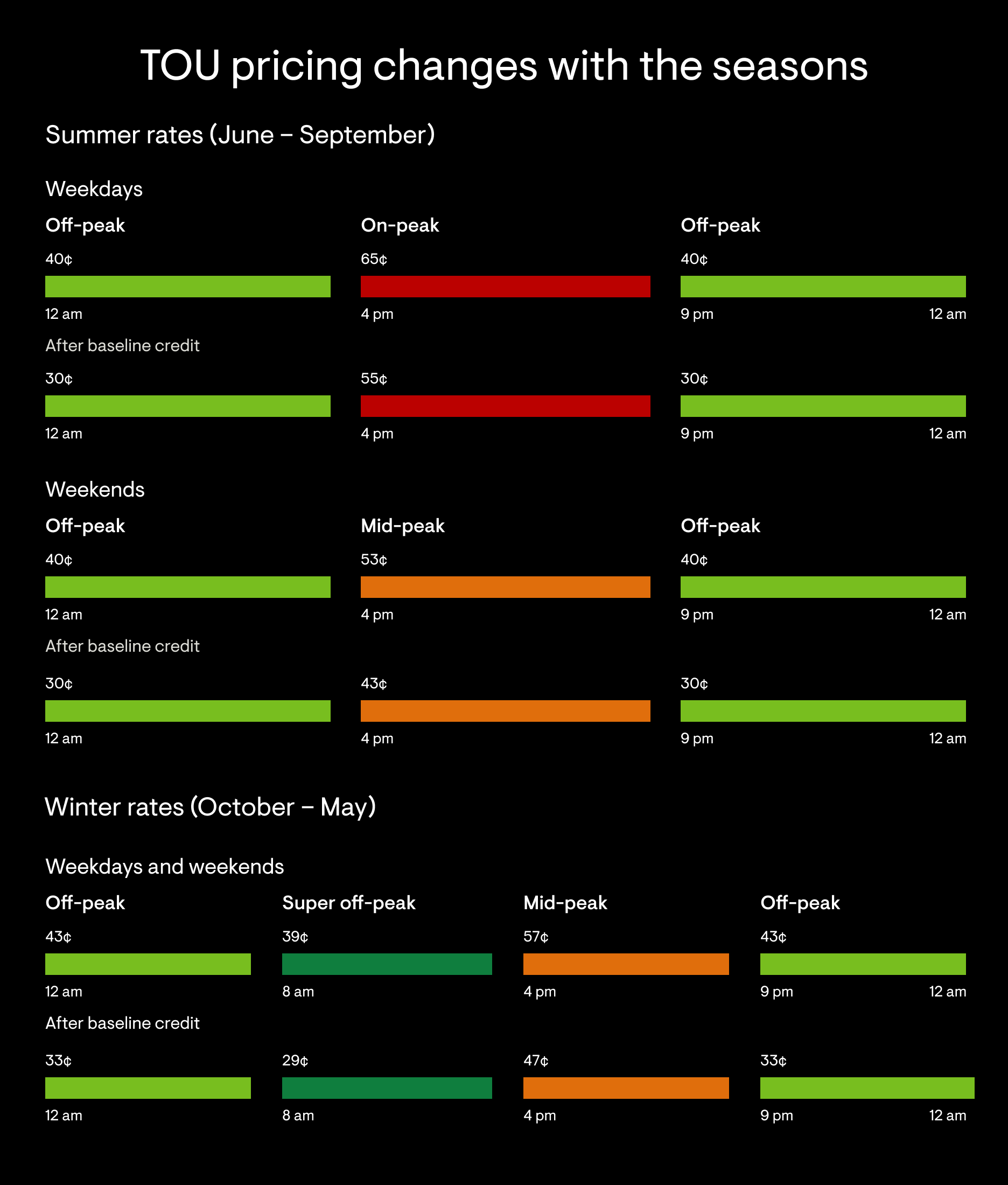
TOU pricing changes with the seasons
Utilities often update TOU schedules twice a year—once for summer and once for winter.
- In summer (June–September)
- Peak demand usually falls in the late afternoon to early evening (around 4 PM–9 PM).
- Off-peak rates apply overnight and during the day until 4 PM, when solar production is typically high.
- In winter (October–May):
- Demand often peaks in the early morning and again in the evening.
- Daytime hours (around 8 AM–4 PM) fall under the super off-peak period, offering the lowest rates.
- Shifting more usage to this window can help reduce costs.
On many holidays, such as Memorial Day, Labor Day, Thanksgiving, Christmas, and New Year’s, peak rates may not apply because overall grid demand is lower.
As you can see in the chart below, utilities such as Southern California Edison often change both the timing and price of electricity between summer and winter.
How to reduce your energy costs under TOU
You don’t need to use less energy, just use it at the right time. Here’s how homeowners are already lowering their bills:
- Run appliances outside peak hours: Dishwashers, laundry machines, pool pumps
- Charge EVs overnight: Many EV apps let you schedule charging
- Pre-cool or pre-heat your home: Let your HVAC work earlier in the day
- Use smart plugs or timers: Automate large loads to shift usage without effort
If you have an EV, check if your utility offers an EV-specific TOU rate with deeper overnight discounts. Even changing the time of just a few major appliances can make a noticeable difference on your bill.
How solar fits into a TOU plan
Solar systems produce most of their electricity during the day—especially mid-morning to late afternoon. That’s great for covering your daytime usage and avoiding grid electricity during mid-peak or off-peak hours.
But here’s the challenge: solar output drops just as TOU rates rise in the evening. So if your system isn’t paired with a battery, you’re still pulling power from the grid at the most expensive time.
And under California’s solar billing plan rules, energy you export to the grid during the day earns much less than what you pay for that same power at night. Export rates also vary hour by hour, and certain evening windows can pay more—which batteries can be programmed to take advantage of. That’s why solar alone doesn’t always maximize savings under TOU.
How batteries make TOU pricing work better
A battery helps you store energy during the day—either from your solar panels or from the grid at off-peak rates—and use it when power is most expensive.
With a battery like the Enphase IQ Battery, you can:
- Capture excess solar production during the day
- Use it at night instead of buying costly on-peak electricity
- Set charge/discharge schedules using the Enphase App
Some utilities, like SDG&E, even offer special TOU plans for battery owners with lower off-peak rates or better export compensation during peak hours. For many homeowners, the best TOU strategy is solar + storage working together. This can also shorten the payback period compared to solar-only systems.
Note: Some utilities limit or require disclosure for grid charging, so check your plan’s rules.
TOU rates are here to stay
As more renewable energy is added to the grid, electricity prices are shifting more throughout the day. TOU rates are how utilities manage this, and they are becoming standard across the country.
Whether you already have solar or are considering it, TOU pricing will shape how you use and save on energy. Understanding it today helps you make better choices for tomorrow.
FAQs on Time of Use rates
In California, homeowners installing solar under the Net Billing Tariff (NEM 3.0) must enroll in a TOU plan. In other states like Arizona, Colorado, and Massachusetts, TOU plans are available but typically optional. Nevada and Hawaii also have TOU as a standard offering, and more states are exploring similar structures. However, more utilities across the U.S. are moving in this direction as part of broader grid modernization efforts.
Solar panels produce energy during the day, but TOU rates are often highest in the evening. That’s when battery storage becomes especially valuable. A home battery stores your excess solar energy and powers your home when rates peak, helping you avoid expensive grid electricity. It can also be programmed to export during high-compensation hours for additional savings.
Yes. You don’t need to change your lifestyle, just automate what you can. Use smart home devices or built-in timers to run high-usage appliances like dishwashers, laundry, or EV chargers during off-peak hours. Even small changes can add up to noticeable savings.
Yes. The Enphase App helps you track energy production and consumption in real time, including when you’re pulling from the grid. You can also review historical reports to see patterns and fine-tune your energy use. This visibility makes it easier to shift usage to off-peak hours and maximize savings under TOU.
Not always. If you can’t shift much of your usage to off-peak hours, a flat rate might be more cost-effective. But with solar and storage, TOU plans often unlock more savings over time, especially in states with favorable net metering structures.