India is among the top few countries in the world leading renewable energy production, with the aim to mitigate the over dependence on the energy produced from non-renewable sources. As per the 14th National Electricity Plan introduced in May 2023, the goal is to double the country’s electricity production by 2032. However, the main emphasis will be on increasing the solar energy production in India to meet the country’s growing electricity demands.
Solar power is one of the cleanest sources of energy that can be harnessed in different ways to generate electricity for domestic and industrial consumption. As a homeowner, a solar rooftop system is a smart way to save a significant amount of money every year that you may otherwise spend on power bills. It’s also important to know that the efficient functioning of solar panels greatly depends on current weather conditions. In this blog, we discuss how different weather conditions can impact solar energy production for your household.
Impact of weather conditions on solar energy production
First, it can be helpful to understand how solar energy is produced. Solar panels are made of photovoltaic cells, which trap heat from the sun and convert energy into electricity. These cells are placed between different layers of semi-conducting materials like silicon, and each of these layers has different electronic properties that get energised when exposed to photons from sunlight. This process creates the current needed to produce electricity and is called the photoelectric effect.
The solar panels then generate direct current (DC), which is passed through solar inverters to convert into alternating current (AC), which can then be used to power your home appliances and devices.
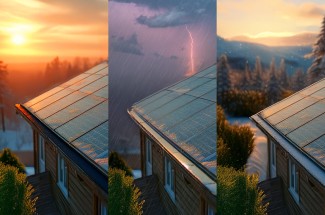
As you consider installing solar panels in your home, you may be wondering about the impact of weather on solar power. While solar panels work to their optimum capacity when the weather is sunny and bright, they can still produce electricity when it’s cloudy, rainy, or snowing outside.
We’ll see how solar panels work in different weather conditions and how those weather conditions impact solar energy efficiency.
Rain
As mentioned above, solar panels rely on photovoltaic cells to absorb and harness the sun’s radiation in the form of photons. Electrons in the solar panels move as they’re exposed to the sun's rays and produce power. However, the efficiency of solar panels can be affected on cloudy days. Solar panels may generate only 30% – 50% of the optimal power-producing capacity. In the case of heavy rains, the number could further reduce to about 10% – 20%, depending on the intensity of the clouds.
Snow
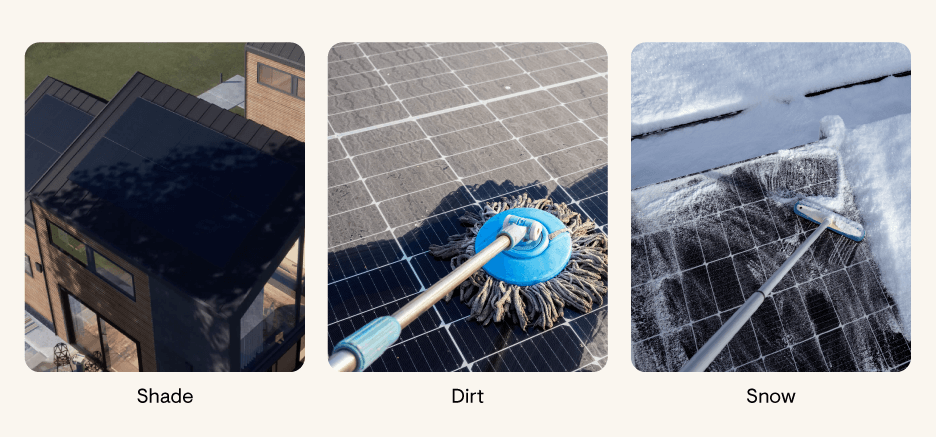
When it snows, the temperature outside drops considerably. Unlike the popular notion that solar panels cannot perform efficiently when there’s snow, cool temperature actually boosts the panel’s voltage production. But if your solar panels get covered under a thick blanket of snow, it may affect the system’s capacity to produce the most electricity, and the volume of current you generate will be less.
If solar panels are installed correctly and placed at the right angle to shed snow naturally, the system will continue to work at its maximum capacity and produce sufficient electricity to power your home.
Research has proven that solar panels still work efficiently in places that receive heavy snowfall. In fact, solar panels have been used as a reliable source of power in regions like Alaska and Antarctica, which are among the coldest regions in the world.
Windy conditions
Water vapour and rain droplets that settle on solar panels generally reflect sunlight from the solar cells. This can reduce the photovoltaic effect and, in turn, the solar energy efficiency of the panels. However, if the weather is windy, blowing wind can speed up the evaporation of water droplets and vapours on the solar panels, keeping them dry. Ultimately, windy conditions can be ideal for solar panels to produce electricity at peak capacity.
Wind can also help cool down solar panels more efficiently and can increase energy production. When your solar panels are functioning at their best, you can generate more electricity, store them in batteries, and use them for days when weather conditions are not ideal.
Dust and pollution
Dust particles from different sources—such as pollution, pollen, and soil erosion—tend to settle on solar panels, covering the photovoltaic cells. Over time, accumulated dust can decrease solar panel efficiency by reducing the amount of light that can be converted into electricity.
Reports have suggested that dust accumulation can decrease the efficiency of solar panels by 15% – 25%, and sometimes even by 50% in extreme cases. In fact, solar panel efficiency can also change depending on location. In cities where pollution level is high, the efficiency of solar panels also decreases. Therefore, it’s important your solar panels receive regular cleaning and maintenance to prevent dust buildup that could affect your solar energy production.
Why homeowners should consider Enphase
Enphase can help make your investment in solar panels and batteries and your commitment to generating your own power worthwhile—beyond your expectations. Enphase delivers a wide range of custom solar solutions that can help you generate your own power for your home so you can stop relying on the power grid.
With an Enphase Energy System, a problem with one panel doesn’t impact the performance of others. If one panel slips into shade, is obstructed by snow or raindrops, or experiences any sort of problem, the other panels can keep operating at peak performance. Enphase microinverters use breakthrough Burst Mode™ technology to capture more energy in low-light conditions, such as when there are shadows or clouds passing over.
With Enphase, you also get an industry-leading warranty. Enphase IQ8 Series Microinverters are covered by a 15-year limited warranty, which can be further extended to 20 or 25 years. With Enphase Energy System’s plug-and-play design, you can simply add more solar panels and microinverters to generate more electricity as your energy needs increase over time.
At Enphase, we understand that every household has different requirements and needs. Our solar advisors will work through the process with you to offer the best solution to fit your needs—ensuring a smooth experience as you switch to solar and take control of rising energy costs.
Conclusion
Weather conditions play a key role in solar energy production and impact efficiency in different ways. While clear skies provide the best outcomes, solar energy systems can still generate power when there’s rain, snow, wind, or dust—though the capacity may be reduced. By understanding these variations, choosing the suitable system, and doing proper maintenance, solar energy systems can continue to perform reliably through diverse weather scenarios.