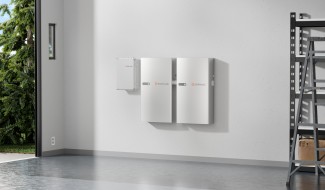
Introducing Enphase storage: an all-in-one alternate current-(AC)-coupled, advanced battery storage system that allows you to easily store the excess energy generated by your solar installation. Enphase storage technology teams up with advanced system monitoring and control software to help your home maintain continuous power, even when the grid is down.
How does Enphase battery storage work?
Your solar energy system will likely be designed to produce energy to meet your annual electricity needs. But there also will likely be times when your system is producing more energy than your home needs, especially during the midday when its production peaks but your power consumption is lower. That’s where an Enphase battery storage system comes into play. It can store that excess energy for use later after the sun sets, and even if the electricity grid goes down when configured for backup.
The seamless integration of Enphase solar and storage systems provides you with unprecedented power over your energy use, helping you achieve energy independence while easily monitoring and controlling your system from the Enphase App. From the app, you can set your system to:
- Power your home using the solar energy right when it’s produced.
- Divert excess solar energy to your Enphase storage for later use.
- Get paid to export your solar energy to the grid (if your state offers net metering or Net Energy Metering [NEM]).
If your solar system produces enough energy, any extra it produces after your battery is full can still be exported to the grid to take advantage of net metering bill credits. In states like California with less-favourable NEM bill credit rates, using your battery to power your home once the sun sets can help you save a significant amount over peak-rate grid power.
To help you maximize your savings, the Enphase App also comes with preconfigured profiles:
- Self-Consumption mode, which allows you to top-up your solar battery storage during the day and discharge it at night. This helps you avoid using and paying for grid power after sunset and overnight if your battery has a large enough storage capacity.
- Savings mode, which is designed for those on time-of-use (TOU) rate plans to get the most savings from their systems. It lets you charge your batteries during non-peak hours (from solar and/or the grid) and discharge them during more expensive times of the day, usually in the evening right after sunset until midnight.
- Full Backup mode, which is designed for long-term solar battery storage. When configured for backup, your batteries will only discharge during outages and other grid failures.
The Enphase App also makes it easy to switch between battery modes if your needs change from time to time. For instance, if you normally use Self-Consumption mode but your local forecast calls for extreme weather, you can switch to Full Backup mode to ensure your battery is fully charged and ready if there’s a grid outage.
Even better, the Enphase App comes with a special Storm Guard™ feature that monitors weather conditions in your area for you. If a storm or major disaster is on the horizon, Storm Guard will automatically put your Enphase battery storage in Full Backup mode to prepare you for weather-related outages. All the above modes come with real-time reporting and home energy monitoring so you can closely track your solar installation’s performance–no matter where you are.
Another good thing is that Enphase offers select U.S.-manufactured IQ Batteries with DOM SKUs designed to support Inflation Reduction Act Domestic Content requirements and FEOC-compliant SKUs. Because eligibility can vary by SKU and project details, confirm with your installer.
Many utilities will provide incentives on a per-kilowatt-hour basis to add storage. For instance, if your utility offers a $200/kWh incentive, then a 10 kWh battery would have a $2,000 rebate.
Enphase storage expands the capabilities of your solar energy system, enabling you to store excess energy production for later use or be prepared to keep the lights on and your critical loads powered if there’s a power outage. It combines energy generation, resiliency, and system monitoring into a single unified ecosystem. This type of protection can be priceless in a world where increasingly extreme weather continues to disrupt grid electricity delivery.
FAQs on solar energy storage
The main differences between the IQ Battery 10T and IQ Battery 5P are the size and power output. The 10T is comprised of three IQ Battery 3Ts with a capacity of 10 kWh, and a 3.84 kW power rating. The 5P has a capacity of 5 kWh, delivering the same 3.84 kW of continuous power. But the 5P delivers a higher peak power output—7.68 kW (for 3 seconds) or 6.14 kW (for 10 seconds), whereas the 10T peaks at 5.76 kVA. The IQ Battery 5P is also more advanced technologically, with six built-in Enphase IQ8 Microinverters providing grid-forming capabilities. And you can add as many as you need to achieve your desired amount of storage capacity.
Both the Enphase IQ Battery 5P and Tesla Powerwall 3 use lithium iron phosphate (LFP) chemistry. But the two systems work differently. Enphase batteries are AC-coupled, meaning they can accept safer AC power from solar panels equipped with Enphase IQ8 Microinverters. The microinverters with the solar panels convert the direct current (DC) to AC right at the panel, send it through the IQ Gateway and from there it goes to your home as needed, with excess going to the battery, where built-in microinverters convert the AC to DC for storage. And then when it’s time to discharge and use the stored energy, the microinverters convert the DC back to the AC that your home uses.
Tesla batteries are high-voltage DC and are typically used with string inverter systems rather than microinverter-based systems.
Microinverters, like the Enphase IQ8, generally have longer lifespans and warranties compared to string inverters. In a string inverter system, solar panels generate DC power, which flows to both the string inverter (to convert it into AC for home use) and the Powerwall (for storage). When power is needed, the battery discharges DC power back to the string inverter, which then converts it into AC for your home.
The main drawback of this setup is that if the string inverter fails, both the solar panels and battery stop working. In contrast, with a microinverter-based system like Enphase, each panel has its own inverter. This means that even if one microinverter fails, the rest of the system continues to operate without interruption.
Solar Plus Battery storage allows you to store excess solar energy generated during the day for use after sunset. However, in this setup, the battery cannot provide power during a grid outage. Instead, it helps offset high peak demand rates by supplying stored energy when electricity prices are typically higher.
Enphase IQ Battery 5Ps is warrantied for 15 years and 6,000 charge/discharge cycles (that’s over 16 years if charged and discharged every day, which doesn’t usually happen). But we design the IQ Batteries to last longer.
Yes! In fact, most residential and commercial solar plus storage systems will be grid-tied. This allows you the added benefit of having access to grid energy for extended periods of cloudy days when your solar might not produce enough to both power your home and fully charge your battery for use overnight.
Enphase batteries can safely run most electric appliances in your home, though heavier loads like heating, ventilating, and air conditioning (HVAC) require you to have sufficient battery capacity. The other consideration is whether you’re using the batteries for self-consumption, where you have the grid standing by if your battery runs low, or if you’re using it for backup when the grid goes down.
If you’re using it for backup when the grid is down, you need to be mindful not to run heavier loads for long periods of time to avoid depleting your batteries overnight before the sun comes up to start powering your home (and recharging your batteries). An IQ Load Controller can help you manage your home’s electrical loads to ensure you have power for critical appliances like your fridge and Wi-Fi/internet connection.