A solar charge controller does exactly what the name implies, it controls how your battery charges, to keep it safe and efficient. By making sure the battery receives power at the right rate and never too much at once, it protects your system from damage and stops energy from flowing backward into the panels at night.
Instead of sending raw solar power straight into the battery, the solar charge controller monitors voltage and adjusts the incoming power as needed. This is why a charge controller for solar panel systems is essential in small off-grid setups like cabins, RVs, and DIY solar generators.
How does a solar charge controller work?
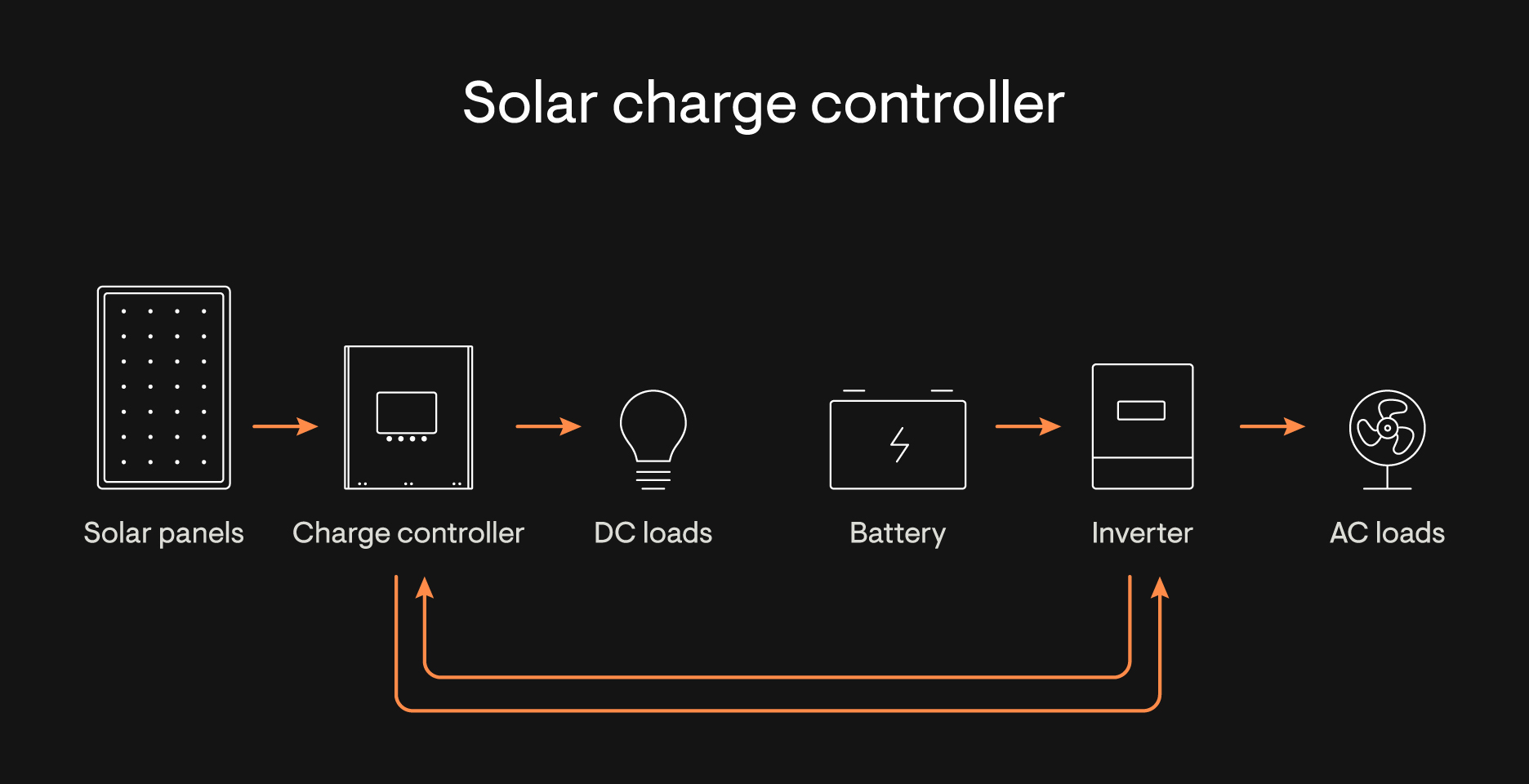
A solar charge controller’s job is to make sure your battery charges safely. The easiest way to picture this is with a glass of water.
When the glass is empty, you can pour quickly. As it starts to fill, you slow down. And once it’s full, you stop pouring. A solar charge controller does the same thing with electricity.
Here’s what it manages behind the scenes:
- It checks how full the battery is (by reading its voltage).
- It controls how much solar power goes in, speeding up or slowing down as needed.
- It stops the battery from getting too much power.
- And at night, it keeps power from flowing backward from the battery into the panels.
All of this happens automatically, helping the battery charge smoothly and last longer.
When do you need a solar charge controller?
Because of its protective role, a charge controller for solar panels is essential in off-grid applications like:
- RV or camper solar systems
- Off-grid cabins
- Small DIY solar generators
- Compact solar generators
- Tiny homes powered entirely by batteries
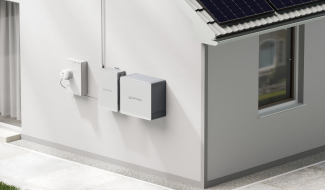
If you're installing a modern rooftop solar system with Enphase microinverters, you do not use a solar charge controller, because Enphase uses an AC-coupled architecture. In Enphase home energy systems, the IQ Combiner 6C supports this AC-coupled design by bringing together system communications, monitoring, and grid connection in one place, eliminating the need for a traditional DC charge controller.
Types of solar charge controllers: PWM and MPPT
There are two main technologies used inside solar charge controllers, and they handle power very differently.
| Feature | PWM charge controller | MPPT charge controller |
|---|---|---|
| How it works | Regulates charging by rapidly switching power on and off (pulsing) | Actively tracks the optimal voltage/current to maximize power |
| Efficiency | Lower (some solar energy is wasted) | Higher (20–30% more usable energy in many cases) |
| Best for | Small 12-volt systems, RVs, basic DIY kits | Medium to large off-grid systems, cabins, higher-power setups |
| Panel + battery voltage | Works best when panel and battery voltages are similar | Can use higher-voltage panels with lower-voltage batteries |
| Cost | Lower | Higher |
| Performance in cold weather | Limited | Better—higher panel voltage is captured efficiently |
Pulse Width Modulation (PWM)
A PWM charge controller is the simpler and more affordable type. Instead of smoothly adjusting the incoming solar power, it rapidly turns the flow of electricity on and off to keep the battery at a safe voltage. These quick “pulses” lower the average voltage going into the battery so it doesn’t receive more power than it can handle.
PWM controllers work best when the solar panel voltage closely matches the battery voltage. That’s why they’re commonly used in small 12-volt systems such as RV setups, basic DIY kits, and compact off-grid installations.
Because they operate by reducing voltage rather than by using all available energy, PWM controllers are less efficient—some of the solar power essentially gets wasted. But for very small systems, their low cost and simplicity make them a perfectly reasonable choice.
Maximum Power Point Tracking (MPPT)
An MPPT solar charge controller is more advanced. Instead of simply pulsing power, it actively analyzes the solar panel output and finds the combination of voltage and current that will deliver the maximum possible power to the battery. It then converts the panel’s output to match what the battery needs at any given moment.
This gives MPPT controllers several advantages:
- Higher efficiency, often 20–30% more usable energy than PWM
- Better performance in cold weather, when panel voltage naturally increases
- Flexibility to use higher-voltage panels with lower-voltage batteries, making system design easier
Because MPPT controllers capture more of the sun’s available power, they’re the preferred choice for medium and large off-grid systems, cabins, and situations where you want the best possible charging performance.
Once you understand controller types, the next step is choosing the right size.
Choosing between a 30 A and 50 A solar charge controller
When you look at charge controllers, you’ll usually see them labeled by their amp rating, such as 30 A or 50 A. This rating tells you how much current the controller can safely handle from your solar panels without overheating or failing, ensuring the system stays protected even during unexpected power spikes.
In simple terms:
• 30 A controllers work for smaller solar arrays or basic off-grid systems with only a few panels.
• 50 A controllers are designed for larger setups that generate more power and need a controller that can safely handle higher current loads.
Solar panels can occasionally produce more power than their rating, especially on bright or cool days. Because of this, installers often choose a controller with a 20 to 25 percent safety buffer to handle those brief surges.
Now that you know how solar charge controllers work and where they fit in, it’s easier to understand the differences between off-grid and modern home solar systems. If you’re considering solar for your home, you don’t have to worry about choosing or managing a charge controller—Enphase systems are designed to handle everything automatically.
Learn how Enphase simplifies solar and storage for homeowners.
Frequently asked questions
Most home rooftop systems do not need a solar charge controller. Charge controllers are used in off-grid or DC-coupled systems where solar panels feed power directly into a battery. Modern grid-tied systems, especially those that use microinverters, convert power to AC at the panel and do not require a separate controller.
Small panels under about 5 watts may not require a controller, but larger panels can overcharge a battery and reduce its lifespan. For almost any off-grid system with a battery, a charge controller is recommended.
Choose a controller based on the maximum current your solar panels can produce. Many installers add a safety margin of 20 to 25 percent to handle occasional power spikes from bright sunlight or cold weather.
The best charge controller depends on the size of your solar array and whether you need PWM or MPPT technology. For most medium to large off-grid setups, an MPPT controller is a better fit because it can capture more usable energy and charge a 200Ah battery more efficiently.
Once you know the total current your solar panels can produce, choose a controller with an amp rating that meets or exceeds that number, plus a 20–25 percent safety margin for occasional power spikes.
No, Enphase systems do not require a charge controller as they are AC-coupled. Each solar panel has a microinverter that converts DC to AC on the roof, so raw DC power never enters the battery.
System monitoring and coordination are handled by integrated equipment like the IQ Combiner 6C, which brings key system connections together in one enclosure. This removes the need for a separate solar charge controller.
Enphase batteries also include built-in power electronics and a battery management system that handle charging internally, so no external charge controller is needed.
Grid-tied systems usually do not require charge controllers because excess solar power flows to the electric grid rather than directly into a battery. Charge controllers are mainly used in off-grid setups.
Yes, but the controller must support the charging profile of the lithium battery type. Many modern controllers include settings for lithium iron phosphate (LFP) batteries, which are commonly used in solar applications.
Most charge controllers last between 5 and 15 years depending on heat exposure, load, and overall build quality. MPPT controllers often have longer service lives due to more advanced electronics.