In the face of rising energy costs and a growing climate crisis, many homeowners are looking for ways to cut their electricity bills and reduce their environmental impact. As solar technologies improve and governments continue to incentivize home solar, rooftop solar systems have become increasingly common.
If you’re interested in alternative energy for your household, there are many options for homeowners to get solar as well as many solar financing structures available, depending on your specific needs. This blog provides an overview and comparison of the available solar financing options for homeowners like you in the U.S.
Note: The content herein is for educational purposes only and should not be relied upon for any other use. Enphase does not provide tax, legal, or accounting advice. Please consult your tax, legal, and accounting advisors to determine your eligibility for any incentives or credits.
Overview of solar financing options
There are several solar financing variables to consider, such as ownership, upfront cost, tax appetite, creditworthiness, and more.
For starters, do you want to be the owner of your solar system? You can often get the best value out of your system when you own it yourself, although homeowners who purchase their systems directly can no longer claim the expired federal residential solar tax credit (Section 25D). State, local, and utility incentives may still be available depending on where you live. As a bonus, the added solar panels increase the value of your property.
Keep in mind, ownership means that you’ll be fully responsible for the operations and maintenance of your system, including fixing any damages or preventing excess degradation of the system.
The upfront cost of home solar can be a large amount of cash to pay all at once—but it’s sometimes the best way to maximize savings if you can afford to do it. Alternatively, you can also take out a solar loan to avoid paying the upfront cost and still maintain ownership of your system. Of course, if you plan to finance your system through a loan, your credit score may be a qualifying factor.
If you don’t care to own the system yourself, you can choose a third-party ownership model with a solar lease or a power purchase agreement (PPA). With this option, a solar financing company or other third party will cover the entire upfront cost, as well as maintain ownership of it throughout the entire lifetime of the system. This way, any maintenance or repairs will typically be the responsibility of the third party—while you get to benefit from the renewable energy produced by the system and pay a monthly fee to do so. Another great option is a prepaid solar lease, where you pay most of the lease cost upfront instead of making monthly lease payments. These arrangements typically include a defined path to ownership, typically after six years, while allowing eligible commercial projects to benefit from commercial clean energy incentives that may help reduce homeowner costs.
The primary factors of each solar financing option are broken down in the table below:
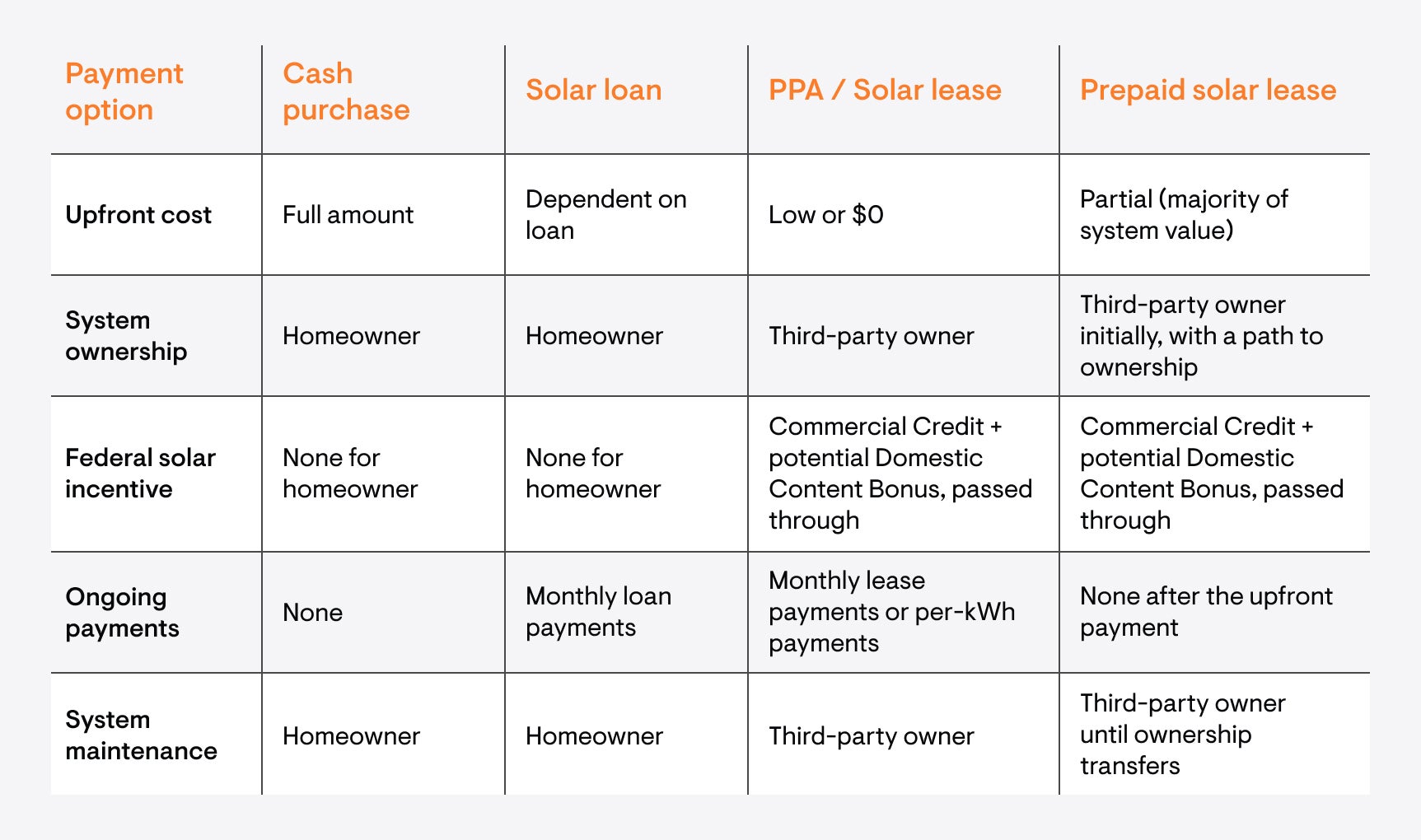
A comparison of solar financing options
Cash purchase
For the highest possible savings, look to purchase your entire solar system upfront. With an upfront cash purchase, you essentially secure roughly 25 years’ worth of electricity, which can protect you from electricity rate fluctuations and provide you with energy independence—the power to produce your own solar energy.
While homeowners can no longer claim the expired federal residential solar tax credit (Section 25D), state, local, and utility incentives may still help reduce your system cost. Depending on where you live, these may include rebates, battery incentives, performance-based programs, net billing or net metering programs, and Virtual Power Plant (VPP) incentives. There are also utility programs that compensate you for excess solar energy exported to the grid, helping improve your system's long-term value.
As the owner, you are responsible for any system maintenance and repairs. However, with your system paid in full, you benefit from no regular payments nor long-term contracts, which in turn allows you to reap the rewards of lowering your electricity bill immediately. Every dollar you save on your electricity bills contributes toward your payback period. While many homeowners recover their investment within approximately 6–12 years, the exact payback period depends on factors such as electricity rates, system performance, energy usage, and available incentives.
Solar loans
For financing that gives you ownership with low-to-no upfront cost, you can take out a solar loan and pay off the cost of your system over time. Like a cash purchase, homeowners who finance with a loan can no longer claim the expired federal residential solar tax credit (Section 25D). However, state, local, and utility incentives may still be available depending on where you live. You’ll also need a solid credit history to qualify for certain solar loans, as with most long-term loans.
Next, there are two types of loans: secured and unsecured. While you need an asset—typically your home or even your solar installation—to serve as collateral for a secured loan, the interest rates for a secured loan tend to run 5% – 12%. In contrast, loan rates of unsecured solar loans, which don’t require a property lien, can be as high as 20 – 22%.
In the states of California, Florida, and Missouri, homeowners can currently access a unique solar financing loan structure called Property Assessed Clean Energy (PACE). Through PACE, you pay back your loan annually through increased property taxes, which are assessed based on the added value of your solar system.
Like other loans, it relieves the burden of the upfront cost and allows you to finance your system over time. It also attaches the debt of the system to the property instead of to you as an individual. PACE programs are typically developed by state legislatures and then authorized by local governments. Check out more information about residential PACE programs.
Solar lease
Solar leases are a great third-party ownership option for those looking to avoid paying the upfront cost of a system. Through a solar lease, you pay for the electricity produced in fixed monthly installments based on the estimated annual production of your system.
Leases can come in two forms: 0% escalators or an annual escalator that increases your monthly payments every 12 months. However, these increases are often lower than annual utility electricity rate increases, so you can still reap long-term electricity bill savings. Solar lease agreements typically range 20–25 years, although some providers now offer buyout or ownership transfer options after several years. Ownership timelines and terms vary by provider, so review your agreement carefully.
Because you don’t own your system, you will forgo the benefits of the expired federal residential solar tax credit (Section 25D). However, third-party owners may qualify for available commercial clean energy incentives under Section 48E, and some providers may reflect a portion of these savings in their pricing. This means that your lifetime savings may be lower than that of a solar loan, which allows you to capitalize on the financial benefits that come with ownership.
Prepaid solar lease
Instead of monthly payments over 20–25 years, you pay most of the lease cost in one upfront sum—typically around 70% of the system value. During this period, the third-party owner may qualify for commercial clean energy incentives and is responsible for system maintenance. Because tax rules require the owner to hold the system for several years to avoid credit recapture, most prepaid leases include a path to ownership, often around six years, through a buyout or ownership transfer.
One example is the Propel lease, which gives homeowners a defined path to ownership after several years instead of remaining in a traditional long-term lease. Eligible projects may qualify for the standard 30% federal investment tax credit (Section 48E) and, where applicable, an additional 10% Domestic Content Bonus, potentially increasing the total available incentive to 40% when paired with FEOC compliant and Domestic content products. Unlike many traditional lease programs, the Propel lease is designed to pass the value of the Domestic Content Bonus on to homeowners through lower project costs or financing, allowing homeowners to directly benefit from the use of qualifying domestic content products. During this period, the provider also handles system monitoring, maintenance, and performance guarantees, giving homeowners peace of mind until ownership transfers.
Prepaid solar leases are a good option for homeowners who want a clear path to ownership without paying the full purchase price upfront or committing to decades of monthly lease payments. Some providers also offer financing for the upfront payment. Terms vary by provider, so review your agreement carefully to understand ownership timelines, buyout options, financing, incentive eligibility, and what happens when the initial ownership period ends.
Power purchase agreement (PPA)
A power purchase agreement (PPA) is another third-party financing option, where the third-party owner sells you the power generated by the solar system, depending on how much you use. If homeowner consumption surpasses the solar system production, a homeowner will simply purchase power from the grid. Like a solar lease, homeowners cannot claim the expired residential solar tax credit (Section 25D), but the third-party owner may qualify for available commercial clean energy incentives, some of which may be reflected in the pricing offered to homeowners. As with a solar lease, a PPA’s monthly payments are based on a fixed rate that’s calculated from the system’s estimated energy production.
However, a PPA can differ from a solar lease in that your payments may vary from month-to-month. A solar lease’s payments are the same every month, no matter how much energy you consume. In contrast, a PPA payment is based on the kilowatt-hours of energy that you consumed during that specific payment period. Because of this, you can expect slightly higher PPA payments during the summer or winter months when you might use your air conditioner or heater more frequently.
PPA agreements typically include annual rate escalators, so your payments may increase over time. But as these increases are often lower than annual utility electricity rate increases, you could still experience long-term savings on your electricity bill.
Solar financing FAQs
Many people finance their solar systems through loans, leases, prepaid solar leases, and power purchase agreements. Those who can afford it may purchase their system outright.
The Enphase System Estimator allows you to customize the optimal system for your home’s needs and estimate the cost of such a system.
It depends. If you can afford the upfront cost, buying a solar panel system gives you direct ownership over the system and provides the most immediate savings on electricity. A loan provides you the benefits of ownership without the upfront cost, however, with a monthly payment, you’re responsible for the operation and maintenance of a system. A lease or PPA, on the other hand, lets you avoid paying the upfront cost through monthly installments for the use of the system, but the hassle of any maintenance is not your responsibility. A prepaid solar lease offers another option by allowing you to pay most of the lease cost upfront while providing a defined path to ownership after several years.
A solar loan is a great financing option for those looking to own their solar system right away but pay off the cost over time. Although homeowners can no longer claim the expired federal residential solar tax credit (Section 25D), state, local, and utility incentives may still be available depending on where you live. A solar lease or PPA might be better if you want someone else to handle the maintenance and upfront cost and are looking to make regular payments over time. If you'd prefer to avoid long-term monthly lease payments while still having a path to ownership, a prepaid solar lease may also be worth considering.
The best solar loan for one person might not be the best for another. You should first determine what your objectives are for going solar. Are you looking for immediate savings or maximum savings? Low rates or a short payback period? You’ll typically find that a secured loan will offer you lower interest rates, and you can lower your overall loan amount by paying as much down as you can.
The Enphase Installer Network is carefully designed to deliver the highest standards of customer service and system quality using Enphase products. Connect with us and get in touch with expert solar installers in your area.