What are the payment options for my system?

There are several ways to pay for a solar energy system. Some payment options give you immediate ownership—cash or a solar loan. Others involve a third-party owner—a lease, a Power Purchase Agreement (PPA), or a prepaid lease, which may reduce your overall upfront system cost by allowing providers to pass their incentives on to homeowners.

Each has trade-offs around cost, ownership, and incentives. A reputable Enphase installer network partner can help you find the option that fits your situation. 
 

Direct purchase

Upfront cash payment: This payment option is often the simplest. You pay for the whole system upfront, which offers the most savings over time because you own the system outright from day 1—and start saving from day 1, too. 

The total cost of a solar energy system depends on factors such as your home's energy needs, system size, equipment, and location. Since you own the system outright, every dollar you save on your electricity bills contributes toward your payback period—the time it takes to recover your initial investment. While many homeowners recover their investment within approximately 6–12 years, the exact payback period depends on factors such as electricity rates, system performance, energy usage, and available state or local incentives.

A cash purchase no longer comes with a federal tax credit (Section 25D), but state, local, and utility incentives may still apply—check DSIRE or SEIA to check applicable incentive programs, or ask your installer what's active in your area. 

Solar loans: This payment method involves getting a loan through your bank or another lender. Many solar loans are offered at $0 down, so you can get your system with little to no upfront down payment. Some solar loans are structured with an optional lump-sum payment after installation that can be applied toward the loan balance. If that payment isn’t made, monthly payments may increase, depending on the loan terms. Loan structures and timing vary by lender, so it’s important to review how incentives or expected savings are factored into your specific loan agreement.  

Interest rates vary on loans based on the term (how many months or years you want to take to repay it) and where you get your loan. Typically, the monthly loan payment is lower than the amount you’ll save on your electricity with a system, which means you can start enjoying savings immediately. There are often additional costs with financing, mainly the interest on the loan and any built-in fees that allow for lower interest rates, which add cost to the system and may impact your payback period. Shorter terms with higher monthly payments tend to have higher ROI because you’ll ultimately pay a lower amount of interest over the term of the loan.

Solar loan sources: There are several sourcing options to get a loan for your solar system. Most common are specialized solar lenders with which your installer may have existing relationships. These solar lenders will typically provide you with a response to your solar loan in seconds, and most will run a soft credit check. Alternatively, some credit unions and banks offer loans designed for solar. 

Other loan alternatives: There are multiple alternatives to solar loans. The most common is taking out a personal loan, which you can get from any bank, credit union, or national lending institution. Taking a home improvement loan is also another option. This is particularly useful if the solar project is part of a bigger renovation of your home. Home equity loans and Home Equity Lines of Credit (HELOC) are other alternatives where the lending institution will provide you with a loan or access to funds using the equity in your home as collateral. You then repay that money like you would any other loan. 

Property Assessed Clean Energy (PACE) financing is another option, which adds the cost of the system repayment to your annual property tax bill over time. All the above options can take longer to get approval, and eligibility can vary depending on your personal circumstances. 

The 30% federal residential solar tax credit expired (Section 25D) for residential solar systems installed after December 31, 2025, so homeowners who buy with cash or a loan can no longer claim it. That doesn't mean all incentive opportunities are gone. Certain prepaid solar lease programs may still help reduce the overall cost of going solar. State and local incentives may also be available depending on where you live.
Third-party owner payment options

Third-party ownership options, including solar leases, Power Purchase Agreements (PPAs), and prepaid solar leases, typically require little or no upfront cost, although prepaid leases are an exception. In these arrangements, a third party owns the system and is responsible for maintenance while they own it.

Since the third-party owner is a commercial entity, they may qualify for the 30% commercial clean energy tax incentives under Section 48E that homeowners purchasing systems directly can no longer claim. Many providers may pass some of these savings on through lower prices or lease payments, making third-party ownership an attractive option for many homeowners.

Some commercial solar projects may also qualify for an additional 10% Domestic Content Bonus when they use eligible U.S.-manufactured equipment (totaling 40% tax incentive credit). Enphase offers qualifying domestic-content products that can help projects meet these requirements, potentially increasing the value of available commercial tax incentives. Eligibility depends on IRS requirements and project-specific circumstances. They must also use FEOC compliant products like Enphase, that are manufactured with a percentage of components that do not come from foreign entities of concern.

Power Purchase Agreements (PPAs): These involve a payment based on your system’s monthly production. Essentially, whatever production the system is generating, you have to pay for that power at a predetermined, per-kWh rate. PPAs also usually have annual rate increases, so your payment can increase over time as well—though these increases are often less than your utility’s rate increases, so you still save over time. Some PPAs do offer a buyout of the system after a certain period, giving you the option to own the system at some point in the future, but this can vary depending on your PPA provider. Be sure to read any potential agreement carefully for details on what happens at the end of your PPA term and any buyout options you may have. 

Solar leases: These involve a payment that’s fixed for your system. Unlike PPAs, the payment amount isn’t necessarily linked to the actual system production but to the estimated annual production. The fixed monthly payment can sometimes have an escalator, which is an annual percentage increase in the monthly payment, but again, most times, this is less than the utility rate increases you’re likely to face. Ideally, these fixed monthly payments will be less than what you would be paying for electricity from your utility, giving you savings that start right away. 

Traditional solar leases are a good option for homeowners who want lower, more predictable monthly electricity costs without purchasing a system outright. Because utility rates can increase unpredictably over time, a lease can help provide greater cost certainty by following the payment terms outlined in your agreement. 

Lease terms are commonly 20 to 25 years. While traditional solar leases often kept the system under third-party ownership for the full lease term, some providers now offer buyout or ownership transfer options after several years. This gives homeowners a defined path to ownership while still benefiting from lower upfront costs. Ownership timelines and terms vary by provider, so review your agreement carefully. 

Prepaid solar leases: Instead of monthly payments over 20–25 years, you pay most of the lease cost in one upfront sum—typically around 70% of the system value. During this period, the third-party owner may qualify for commercial clean energy incentives and is responsible for system maintenance. Because tax rules require the owner to hold the system for several years to avoid credit recapture, most prepaid leases include a path to ownership, often around six years, through a buyout or ownership transfer.

One example is the Propel lease, which gives homeowners a defined path to ownership after several years instead of remaining in a traditional long-term lease. Eligible projects may qualify for the standard 30% federal investment tax credit (Section 48E) and, where applicable, an additional 10% Domestic Content Bonus, potentially increasing the total available incentive to 40% when paired with FEOC compliant and Domestic content products. Unlike many traditional lease programs, the Propel lease is designed to pass the value of the Domestic Content Bonus on to homeowners through lower project costs or financing, allowing homeowners to directly benefit from the use of qualifying domestic content products. During this period, the provider also handles system monitoring, maintenance, and performance guarantees, giving homeowners peace of mind until ownership transfers.

Prepaid solar leases are a good option for homeowners who want a clear path to ownership without paying the full purchase price upfront or committing to decades of monthly lease payments. Some providers also offer financing for the upfront payment. Terms vary by provider, so review your agreement carefully to understand ownership timelines, buyout options, financing, incentive eligibility, and what happens when the initial ownership period ends. 

Compare payment options

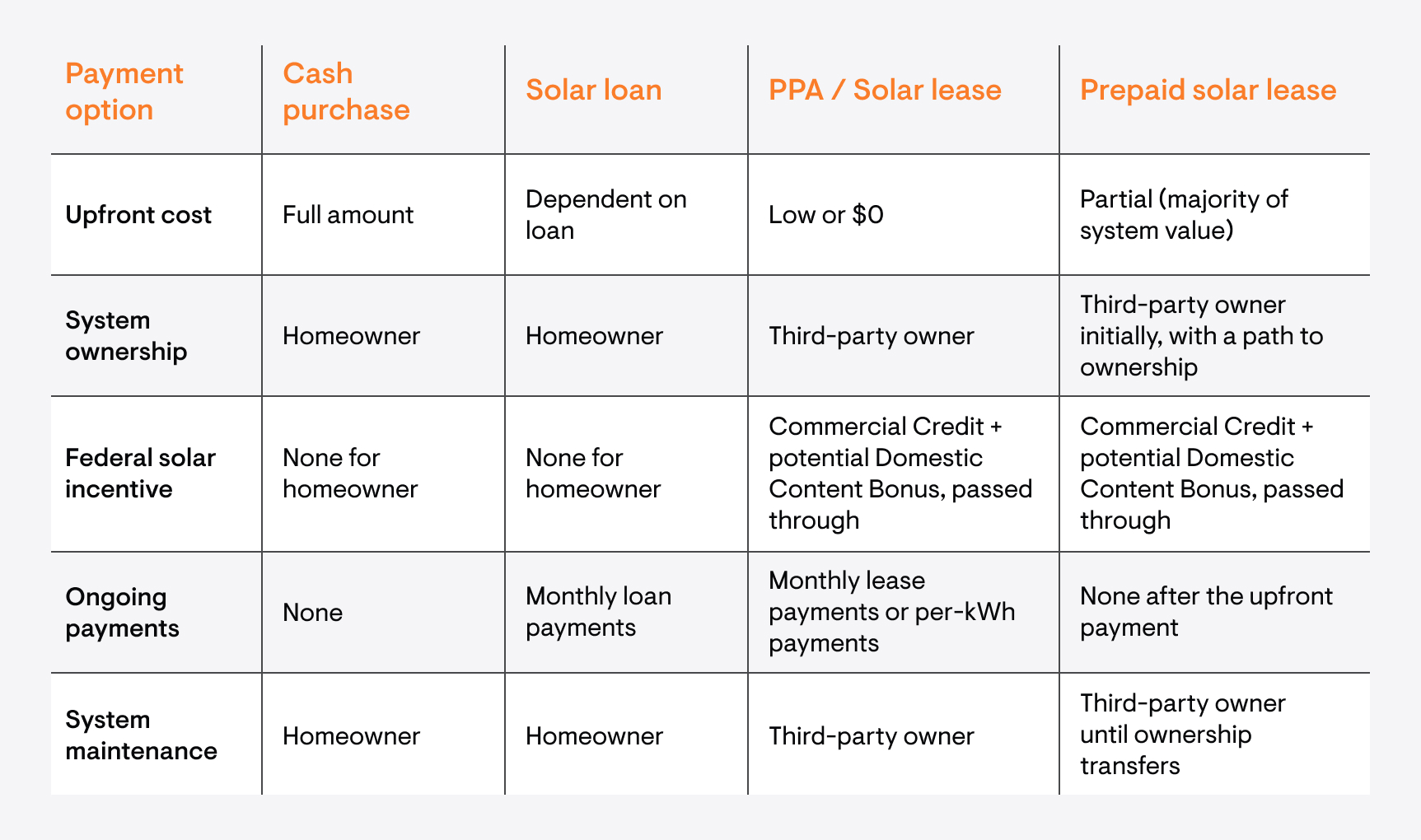
This comparison can help you decide which payment option best fits your budget, ownership goals, and long-term savings.

Comparison chart of different features

You can learn more here: Solar financing options

Financing FAQs

Can I still benefit from federal clean energy incentives if I lease my system? 
While homeowners who purchase systems directly can no longer claim the expired residential federal solar tax credit (Section 25D), third-party owners may still qualify for available commercial clean energy incentives. Many leasing providers reflect some of these savings in their pricing, helping reduce lease costs for homeowners. The amount of savings passed through varies by provider. 

How does a prepaid solar lease differ from a regular lease? 
A regular lease spreads payments monthly over the full lease term. A prepaid solar lease lets you pay most of the lease cost upfront, typically eliminating monthly lease payments while providing a defined path to ownership after several years. Ownership timelines and buyout options vary by provider, so review your agreement carefully to understand when ownership may transfer and what terms apply.  

What considerations should I have for loan terms? 
The factors you should consider aren’t much different than for other loans, such as for a car purchase. Look at interest rates, repayment times, monthly repayment costs, and whether there are any fees attached to the loan. Then, balance those against your expected monthly savings on electricity to see what works for you financially. If you want to own the system outright sooner and can afford a higher monthly payment, a shorter term may be the best option. If you want the lowest monthly payment, then you may want to choose a longer term. 

Do credit scores matter for solar financing? 
If you’re paying cash upfront for your system, your credit score is a non-issue. However, if you intend to get a loan for your system, your lender will likely consider your credit score when approving or setting terms for your loan. Similarly, your credit is considered for leases and PPAs. However, it’s not necessarily as stringent since those options are through a third-party owner. 

Are there prepayment penalties for solar loans or leases? 
That will depend on your financing partner. Some lenders do include a prepayment penalty since they lose out on interest money if you repay it early. Be sure to ask your lender whether they charge an early repayment penalty. 

What type of partnerships do installers have with lenders? 
You’ll often see solar installers offering financing for systems. This is usually in partnership with lenders who offer loans or third-party owners who offer solar leases or PPAs. The reason you may see dealers offer financing first is that the upfront cost of a system can be a barrier to getting solar for many homeowners. Much like how financing can make it possible to buy a car, spreading the cost of the system over several years can make going solar more accessible. 

Is free solar a scam? 
The energy generated by the sun is free, but the equipment to harness it still costs money. In general, if someone is advertising “free solar,” proceed with caution. Their offer might mean you don't pay anything upfront or that your electricity payments can be redirected to cover the monthly cost of installing solar panels, so there’s no additional expense for you. However, we strongly encourage you to read the details of any agreement to fully understand the incentives and the total costs of the system.